S'entraîner à l'impossible, un été après l'autre
LE GROENLAND EN KITE
Parler
Le long chemin vers l'Antarctique
Lorsque l'aventurier français Matthieu Tordeur m'a appelée pour me demander si je voulais traverser l'Antarctique en ski-kite, il n'y avait qu'un seul détail à régler : je n'avais jamais fait de kite de ma vie. Ce qui a suivi, ce sont deux étés au Groenland — 2024 et 2025 — à apprendre une discipline entièrement nouvelle sur l'un des terrains les plus exigeants de la planète, tout en collectant des données scientifiques sur la calotte glaciaire. Voici l'histoire de ces deux expéditions : des champs de crevasses qui dominent Ilulissat à la station fantôme de DYE-2, de la quasi-hypothermie dans le brouillard du sud à un accident évité de justesse dans un canyon au-dessus de Qaanaaq. Deux traversées, des milliers de kilomètres, et bien des choses encore à venir.
Parler
LE GROENLAND EN KITE
UN APPEL TÉLÉPHONIQUE QUI CHANGE TOUT
Il y a quelques années, Matthieu Tordeur m'a appelée avec une proposition soit visionnaire, soit complètement folle — peut-être les deux. Il voulait traverser l'Antarctique en ski-kite. Il me voulait dans l'équipe et à la tête du programme scientifique de l'expédition. Il y avait un problème : je n'avais jamais fait de ski-kite de ma vie. Je n'avais jamais fait de kitesurf non plus. À vrai dire, je n'avais même jamais tenu un cerf-volant de quelque sorte que ce soit dans l'intention de me laisser tracter où que ce soit.
J'ai dit oui.
Ce qui a suivi, ce furent de longs mois d'entraînement intensif — en France, en Norvège, au Svalbard, et aux côtés de quelques-uns des kiteurs les plus expérimentés de la planète. Le ski-kite est d'une technicité trompeuse. Le kite n'est pas une simple voile : c'est un système dynamique et tridimensionnel qu'il faut piloter avec une attention de tous les instants, en lisant le vent, en anticipant les rafales, en gérant des lignes qui peuvent s'emmêler de façons allant du désagréable au ridicule. Les progrès sont venus, mais lentement. Chaque séance m'apprenait quelque chose de nouveau, et chaque nouveauté apprise révélait trois autres choses que je n'avais pas encore comprises.
Le plan était de faire du Groenland un terrain d'essai — à deux reprises, lors de deux étés consécutifs — avant la tentative en Antarctique. Non seulement pour développer nos compétences en kite, mais aussi pour répondre à une question qui comptait sur le plan scientifique : était-il possible de recueillir de véritables données de recherche tout en traversant une calotte polaire en ski-kite ? Nous comptions bien le découvrir.

LE COULOIR DE CREVASSES
Notre entrée sur la calotte glaciaire du Groenland nous a placés à proximité du Sermeq Kujalleq — le glacier Jakobshavn —, et ce n'était pas un hasard. Ce n'était pas non plus de tout repos.
Le Sermeq Kujalleq est l'un des glaciers les plus rapides de la planète, avançant de plusieurs dizaines de mètres par jour. Il draine vers l'océan environ six à sept pour cent de l'ensemble de la calotte glaciaire du Groenland — une part énorme d'un système immense, le tout canalisé par un seul exutoire. La conséquence de cette vitesse, c'est que la glace de cette région est soumise à des contraintes colossales : fracturée, intensément crevassée. Certaines crevasses sont visibles. Beaucoup ne le sont pas.
Avant le départ, Matthieu et moi avions soigneusement défini nos points de passage, traçant un étroit corridor de glace plus lente qui nous permettrait de gagner de l'altitude vers l'est le plus vite possible. Nous nous étions fixé une règle stricte : rester entre 2 200 et 2 500 mètres d'altitude, là où la glace est plus lente et où les crevasses qui caractérisent les marges inférieures du glacier sont laissées derrière soi ou enfouies sous des mètres de neige.
La première journée de kite fut, pour être honnête, ce qu'on appelle du « type 2 fun » — le plaisir qui ne se savoure qu'après coup. Je sortais tout juste de plusieurs mois de pneumonie. Ma forme physique était au plus bas depuis longtemps. Et mon niveau de kite n'était guère plus élevé.
Les exigences techniques se sont imposées d'emblée. Les kite loops — une manœuvre de base pour les pratiquants expérimentés — étaient nécessaires presque dès le début pour générer de la puissance dans un vent qui ne soufflait pas de la direction voulue. Je ne maîtrisais pas les kite loops. Je les avais à peine travaillés. Nous étions en outre cernés par les lacs supraglaciaires — ces étendues d'eau de fonte qui reposent sur la surface de la glace en été — et le gain d'altitude dont nous avions désespérément besoin se faisait obstinément lent. Chaque mètre d'élévation semblait durement gagné.
Mais au bout de quelques jours, nous avons fini par percer.


DANS LE BLANC
Atteindre l'altitude de croisière a tout changé.
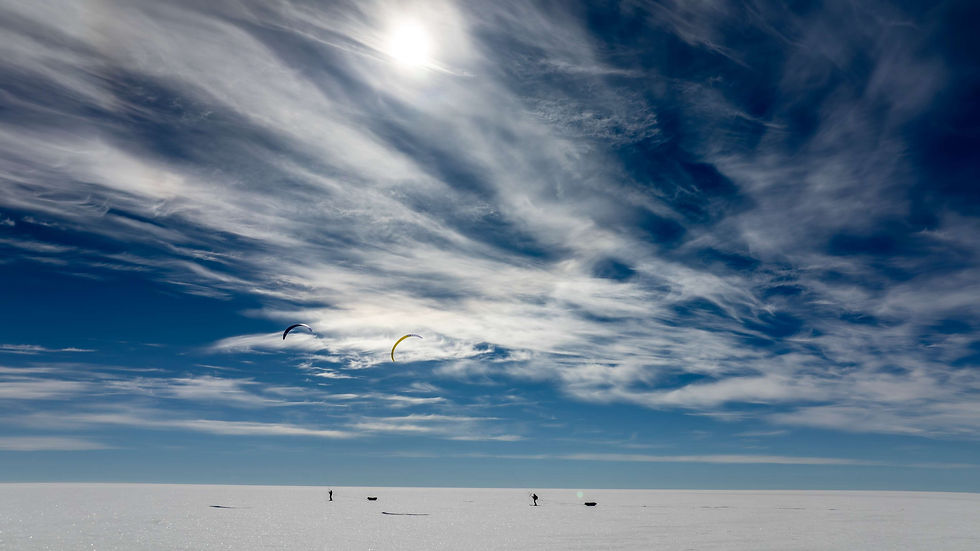
Vers 2 200 mètres, le terrain s'est aplani, les crevasses ont disparu sous nos pieds, et le vent a basculé dans notre dos. Nous avons mis le cap au nord, et soudain la calotte glaciaire est redevenue telle que je me la rappelais avant de comprendre à quel point l'approche serait difficile : plate, blanche, immense, silencieuse, hormis le bruit des skis sur la neige et la traction sourde des kites au-dessus de nos têtes.
La surface de la neige était extraordinaire. Une fine couche de neige fraîche sur une base ferme offrait des conditions aussi proches de la perfection pour le ski-kite que je puisse l'imaginer — lisses, régulières, rapides. Les pulkas — nos traîneaux, chargés chacun de plus de cent vingt kilos d'équipement et de provisions — glissaient derrière nous presque sans effort. Le monde se réduisait à quelques éléments simples : le vent, la neige, l'horizon, et l'attention de chaque instant qu'exige le maintien du kite en vol.
J'apprenais encore. Chaque heure passée dans ces conditions m'enseignait des techniques que je n'avais pas eu l'occasion de pratiquer à l'entraînement : comment le kite se comporte différemment selon la vitesse du vent, comment lire les subtiles variations de texture en surface qui trahissent un changement de densité de la neige en dessous, comment rester détendue dans le harnais au fil d'heures d'effort soutenu. Les progrès d'un kiteur ne sont pas linéaires — ils surviennent par bonds soudains de compréhension, ces instants où un geste mécanique devient instinctif. Plusieurs de ces instants ont eu lieu là-haut, sur le haut plateau.
Environ une semaine après le début de l'expédition, nous avons vu les halos.


ILULISSAT ET LA LISIÈRE DE LA GLACE
Nous sommes arrivés fin juin 2024 et avons passé plusieurs jours à Ilulissat avant le début de l'expédition.
Ilulissat se trouve sur le rivage de la baie de Disko, dans l'ouest du Groenland, et est inscrite au patrimoine mondial de l'UNESCO — pour des raisons qui deviennent évidentes à l'instant même où l'on découvre les lieux. Le fjord glacé d'Ilulissat — relié au glacier Sermeq Kujalleq, son nom en groenlandais — est l'un des glaciers les plus productifs de la planète, vêlant des quantités colossales de glace dans la baie en une procession quasi ininterrompue. Les icebergs qui défilent au large de la ville sont des monuments : certains plus hauts que des immeubles, d'autres de la taille d'un pâté de maisons, tous d'un blanc bleuté lumineux, presque irréel, dans la lumière arctique.
Nous nous sommes rendus plusieurs fois sur le site de l'UNESCO. Nous avons aussi consacré ces journées au travail ingrat mais essentiel qui précède chaque expédition : trouver du carburant, acheter des vivres, vérifier et revérifier le matériel scientifique. Nous emportions deux objectifs scientifiques sur la glace — des mesures de densité de la neige à intervalles réguliers, et le prélèvement d'échantillons de neige destinés à une analyse ultérieure de la concentration en carbone suie. Aucune de ces deux missions n'était anodine. Toutes deux étaient réalisables, si les conditions le permettaient.
Nous avons attendu la météo. Le 28 juin 2024, nous sommes partis.


L'ŒIL DU GROENLAND
Les halos solaires sont un phénomène optique produit lorsque la lumière du soleil se réfracte à travers les cristaux de glace en suspension dans l'atmosphère. Sur le plateau, dans les bonnes conditions, ils forment des anneaux complets autour du soleil — des cercles de lumière lumineux, parfois accompagnés d'arcs et de piliers supplémentaires, capables d'emplir le ciel tout entier. Nous nous sommes arrêtés pour les contempler. Là-bas, sans rien autour de nous sur des centaines de kilomètres dans toutes les directions, on avait l'impression que le Groenland lui-même nous regardait.
Le halo n'a pas duré. Au cours des jours suivants, à mesure que nous progressions vers le nord, le temps s'est dégradé. Le voile blanc — où les nuages et la surface de la neige se confondent en un seul gris indifférencié — rendait la navigation de plus en plus ardue. Sur la calotte glaciaire, un voile blanc n'est pas un simple désagrément. Il supprime tout repère visuel du sol, rendant impossible d'évaluer la pente, la texture ou les obstacles. On navigue au GPS et au ressenti.
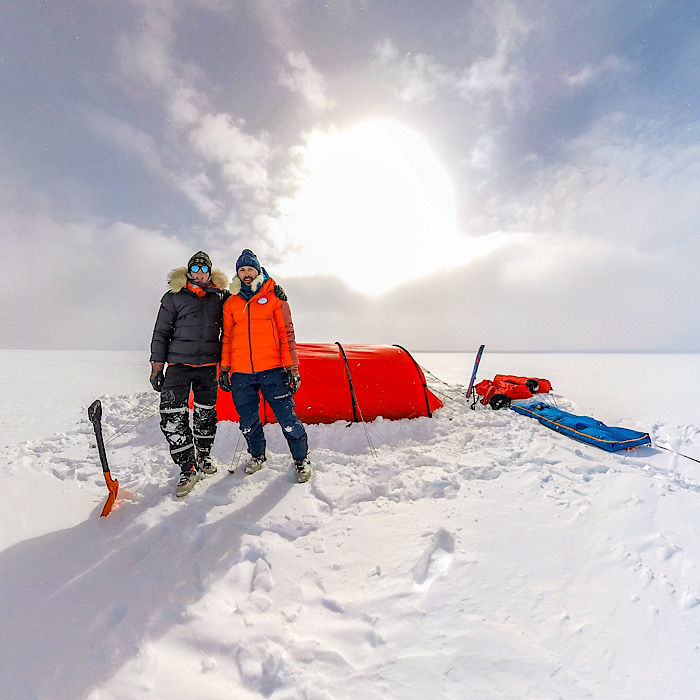
Un jour où le vent est tombé complètement, nous nous sommes arrêtés pour travailler. Matthieu et moi avons creusé un double puits de neige — une excavation en parallèle qui permet de comparer la structure du manteau neigeux sur une petite distance horizontale —, relevant la stratification, la densité et la température de la neige en profondeur. Nous avons prélevé des échantillons de neige, que Matthieu a fait fondre et filtrés sur place, puis conservés en vue d'une analyse ultérieure du carbone suie. Dans le silence de la calotte glaciaire sans vent, la science prenait tout son sens, claire et essentielle : c'est pour cela que nous étions venus.


LA DESCENTE, L'ATTENTE, LE CANYON
Le 12 juillet, après des jours de navigation difficile dans une mauvaise visibilité, nous avons amorcé le grand virage vers Qaanaaq — le défi de navigation le plus exigeant qui nous restait. L'itinéraire nous imposait de suivre une crête invisible sur le terrain, mais clairement définie sur les images satellite et les cartes topographiques.
Puis le ciel s'est dégagé.
Des montagnes sont apparues à l'horizon — des formes sombres et massives sur le ciel blanc. Nous avions les larmes aux yeux et dans la voix. Après deux semaines sur la glace, la vue de la roche signifiait que nous approchions de la marge de la calotte. Nous touchions presque au but. L'euphorie a duré une vingtaine de minutes.
À mesure que nous descendions, la neige s'est rapidement dégradée. La glace ferme a cédé la place à de la neige fondante, puis à une bouillie épaisse et gorgée d'eau, qui freinait les pulkas et rendait le kite de plus en plus précaire. Les premières crevasses sont apparues, puis des chenaux d'eau de fonte qu'il fallait franchir avec précaution, un à un. Sur les derniers kilomètres, j'ai pris la décision de poser le kite et de tirer mes skis à la main plutôt que de risquer une chute ou une blessure si près de l'arrivée — le genre d'accident qui survient à la fin des expéditions, quand l'attention se relâche et que la fatigue prend le dessus.
Nous avons campé sur la marge de la calotte glaciaire, à huit kilomètres du fjord. Et puis nous avons attendu.
Un bateau ne pourrait nous atteindre que lorsque la banquise du fjord se serait suffisamment dégagée pour permettre la navigation. Mark, notre routeur météo, nous envoyait des prévisions quotidiennes, et des amis restés chez nous — Nina et Yann, parmi d'autres — surveillaient pour nous les images satellite de l'état des glaces. Cela pouvait prendre quelques jours ou quelques semaines. Nous avions des vivres. Nous avons commencé à acheminer le matériel vers la côte à pied, en portant 25 à 30 kilos à la fois, parcourant deux kilomètres par trajet avant de revenir en chercher davantage — des portages quadruples, quatre fois la distance à parcourir à pied.
Le deuxième jour de portage a bien failli très mal tourner. Nous sommes partis sans avoir reconnu l'itinéraire au préalable — une erreur — dans un brouillard quasi total, en suivant des points GPS recopiés auprès d'un ami. Ces points nous ont menés dans un canyon. Le canyon s'est creusé. Les parois sont devenues abruptes et le passage s'est rétréci, jusqu'à ce que nous nous retrouvions au bord d'une cascade — d'au moins cinquante mètres de haut —, sacs chargés sur le dos, visibilité nulle, et aucun moyen évident d'avancer ou de reculer. Un territoire potentiel d'ours blancs, des falaises, une grande cascade et du matériel lourd : tout ce qu'on ne veut surtout pas réunir en même temps. Nous avons vite compris que nos coordonnées GPS étaient fausses.
Un ami, joint par téléphone satellite, nous a envoyé des coordonnées GPS corrigées. Nous avons retrouvé le bon chemin.
Avec le recul, je déconseille de suivre des points GPS — qui plus est erronés — dans le brouillard sans reconnaissance préalable. Ce jour-là, nous avons eu de la chance.
Après quelques jours de portage supplémentaires, la banquise s'est dégagée. Le 18 juillet 2024, un bateau est apparu dans le fjord. Ce fut l'un des moments les plus heureux de l'expédition. Nous avons été conduits jusqu'à Qaanaaq.


RETOUR VERS LE SUD : QAQORTOQ 2025
Qaanaaq, l'un des établissements habités les plus septentrionaux de la planète, nous a offert quelques jours de repos, d'entretien du matériel et de réflexion. L'expédition de 2024 avait répondu à certaines questions et en avait soulevé d'autres. Nous avions prouvé que les mesures de densité de la neige et le prélèvement de carbone suie étaient réalisables en ski-kite. Nous avions appris, précisément et parfois douloureusement, où se situaient les limites de cette science dans des conditions difficiles. Nous avions davantage confiance dans les kites. Nous n'étions pas encore prêts pour l'Antarctique.
Nous nous sommes donc préparés pour une deuxième année.
En août 2025, nous sommes arrivés à Qaqortoq, dans le sud du Groenland — un paysage très différent du haut plateau arctique. Cette fois, nous transportions un radar à pénétration de sol d'une portée de 60 mètres de profondeur, conçu par Blue Ice Systems pour imager la structure interne du manteau neigeux et de la glace sous-jacente. Notre itinéraire reliait Qaqortoq à Kangerlussuaq, soit environ six à sept cents kilomètres, en une dizaine de jours si les conditions le permettaient.
Les conditions ne l'ont pas permis.
Le sud du Groenland, en été, est plus chaud, plus humide et plus imprévisible que le haut plateau. Dès les premiers jours, nous faisions du kite dans un brouillard si épais et si humide que des cristaux de glace se formaient sur les kites et les lignes, les alourdissant et les rendant poussifs dans les vents faibles auxquels nous avions affaire. Puis vint la pluie.
Je me souviens d'une journée en particulier dans le détail. J'étais trempée à travers chaque couche de vêtements, jusqu'à la couche de base, et je sentais le froid commencer à gagner le cœur de mon corps. J'ai dit à Matthieu que si nous nous arrêtions de nouveau, il nous faudrait monter la tente sur-le-champ. Faire du kite avec le vent dans le dos me tenait suffisamment chaud. Mais dès que je ralentissais ou m'arrêtais, le vent m'arrachait la chaleur plus vite que mon corps ne pouvait la reconstituer. Nous avons monté la tente. J'ai retiré mes vêtements trempés, enfilé des couches sèches, et passé deux bonnes heures à boire de l'eau chaude au fond de mon sac de couchage. Il s'en est fallu de peu.
Le lendemain matin a apporté un soleil inattendu. Nous avons tout étalé dehors pour faire sécher — sacs de couchage, vêtements, kites, lignes — et ce qui a suivi est devenu l'une de nos plus belles journées de l'expédition : de bonnes conditions, une progression rapide, le radar collectant ses données proprement tandis que nous le tractions à travers le plateau. Nous avions prouvé qu'un radar à pénétration de sol pouvait être mis en œuvre en ski-kite. Les batteries ont posé des difficultés que nous avons soigneusement notées en vue de les améliorer. Mais le concept fonctionnait.




LA COURSE DE NUIT
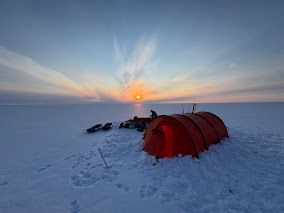
Quelques jours plus tard, la chaleur du jour rendait le kite impossible. La neige s'était ramollie au point que tracter la luge du radar revenait à la traîner dans du sable mouillé. Nous avons décidé d'attendre le soir, lorsque les températures chuteraient et que le vent se lèverait, comme à l'accoutumée, pour faire du kite à travers la nuit.
Nous sommes partis vers vingt ou vingt et une heures, avec un objectif de quatre-vingt-dix kilomètres.
Ce qui a suivi fut l'une des nuits les plus extraordinaires de ma vie.
Le soleil de minuit s'était couché dans cette partie du Groenland, et sur de longues portions nous faisions du kite dans une quasi-obscurité. Nous ne voyions pas la surface de la neige sous nos skis. Nous nous distinguions à peine les uns les autres. Naviguer signifiait consulter régulièrement le GPS, choisir un nuage à l'horizon vers lequel se diriger, et se fier au cap de la boussole entre deux vérifications. Nous restions groupés, nous nous attendions par intervalles, nous avancions sans cesse. La nuit s'étirait, interminable. Les aurores boréales semblaient là pour nous tenir éveillés.
Vers trois ou quatre heures du matin, quelque chose est apparu à l'horizon.
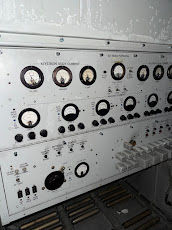
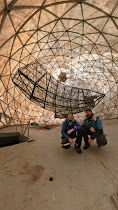
DYE-2 est une ancienne station radar de l'armée de l'air américaine, construite dans le cadre de la ligne d'alerte avancée (Distant Early Warning Line) pendant la Guerre froide, et abandonnée en 1988. Elle se dresse sur la calotte glaciaire du Groenland, à environ 2 100 mètres d'altitude : une vaste structure surélevée sur pilotis, jaillissant de l'étendue blanche et plate dans un isolement total. Après des heures de kite dans l'obscurité, la voir émerger du ciel nocturne nous a bouleversés. Nous riions. L'aube commençait tout juste à effleurer l'horizon.
Nous avons trouvé l'entrée après plusieurs heures de recherche — une porte presque ensevelie sous la neige, par laquelle il fallait ramper pour pénétrer à l'intérieur. Ce qui s'y trouvait était un lieu figé dans le temps : équipements, mobilier, les détails de la vie quotidienne, tout laissé exactement tel quel depuis 1988, conservé par des décennies de froid. On avait l'impression d'entrer dans une photographie. Aussi troublant qu'extraordinaire — la plus belle exploration urbaine que j'aie jamais faite, et la première.
Sur un mur, nous avons découvert des messages laissés par des expéditions précédentes. Parmi eux, un message de Dixie Dansercoer, l'explorateur polaire belge qui réalisa plusieurs traversées du Groenland et de l'Antarctique en ski-kite avant sa mort en 2021. Lire ses mots, dans ce bâtiment gelé posé sur la calotte glaciaire qu'il avait lui aussi traversée en kite, fut un moment d'émotion silencieuse.



SKI NAUTIQUE
Nous nous sommes reposés quelques heures, puis nous sommes repartis dans l'après-midi, en changeant de direction vers Kangerlussuaq. Presque aussitôt, nous avons commencé à perdre de l'altitude.
Le lendemain matin, la neige avait disparu, au sens propre du terme. Une fine croûte de glace recouvrant un manteau neigeux complètement gorgé d'eau se brisait dès qu'on y posait son poids, nous laissant debout dans l'eau liquide. Des lacs supraglaciaires apparaissaient dans toutes les directions. Tracter la luge du radar relevait presque de l'impossible. Nous ne skiions plus sur la glace. Nous faisions, au sens le plus littéral, du ski nautique.
Nous avons tenu encore deux jours, nous faufilant entre les lacs et les sections gorgées d'eau, cherchant à gagner du terrain vers la côte. Pour finir, je me suis retrouvée coincée dans un lac, de l'eau jusqu'aux cuisses, les skis bloqués sous la glace et le kite qui me tirait dans l'autre sens. Les conditions ont décidé pour nous. Nous avons demandé à être récupérés.
Le 24 août 2025, nous avons atteint Kangerlussuaq — la ville située au fond de l'un des plus longs fjords du Groenland, et le point d'arrivée de plus d'expéditions polaires que je ne saurais en compter. Le sentiment d'arriver tenait autant du soulagement que du triomphe.
Deux étés. Deux traversées. Le radar à pénétration de sol avait fonctionné. Les échantillons de carbone suie étaient collectés. Les données étaient entre les mains des scientifiques qui en avaient besoin. Et nous avions appris, de la manière la plus directe qui soit, ce qu'exige réellement la traversée d'une calotte polaire en ski-kite — en compétence, en endurance, en matériel et en discernement.
Après Kangerlussuaq, je suis retournée à Ilulissat pour quelques semaines encore, afin d'y enseigner un cours sur le changement climatique — un rappel, s'il en fallait un, de la raison pour laquelle tout cela compte. Puis je suis rentrée chez moi pour préparer la suite.
L'Antarctique nous attend.


